
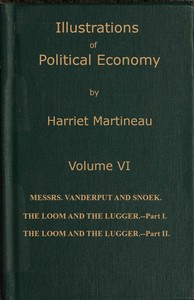
Illustrations of political economy, Volume 6 (of 9) by Harriet Martineau
Harriet Martineau's Illustrations of Political Economy is a unique project. This sixth volume continues her ambitious mission: to explain the complex principles of economics through the power of story. Instead of charts and dry lectures, she creates fictional worlds and characters who live out these ideas.
The Story
There isn't one single plot. This volume contains several distinct tales, each a self-contained lesson. You might follow a community whose well-being rises or falls based on their understanding of trade. Another story could focus on a family navigating the realities of wages and the cost of living. Martineau crafts scenarios where characters face tangible problems – poverty, scarcity, or unfair competition – that are directly caused by economic policies or a lack of economic knowledge. The narrative tension comes from watching them grapple with these forces, often learning the hard way how things like currency value, international trade, or taxation actually work in practice. The 'aha' moments in the story are both personal for the characters and educational for the reader.
Why You Should Read It
What struck me most was Martineau's deep faith in the public's intelligence. She didn't write this for experts; she wrote it for everyday people because she believed they needed to understand these forces that shaped their lives. Her writing is clear and purposeful. While the stories are from the 1830s, the core issues feel weirdly familiar: debates about fair pay, the impact of foreign goods on local jobs, and how government decisions trickle down to the kitchen table. Reading it, you get a double history lesson: one about economic thought in the Industrial Revolution, and another about a woman fiercely advocating for public education and rational debate. It's a book with a clear, persuasive agenda, and that passion is contagious.
Final Verdict
This is perfect for curious readers who enjoy history, ideas, and unique literary experiments. If you like books that make you think about how society works, or if you've ever wished someone would explain the economy in plain language with real-world examples, Martineau's your guide. It's not a light beach read, but it's far more engaging than any textbook. Think of it as the ancestor to today's narrative nonfiction and explainer journalism—a bold, clever, and deeply human attempt to demystify the world.
There are no legal restrictions on this material. You do not need permission to reproduce this work.
Ashley Rodriguez
10 months agoI wanted to compare this perspective with traditional views, the footnotes provide extra depth for those who want to dig deeper. I'll be recommending this to my students and colleagues alike.
Andrew Smith
1 year agoJust what I was looking for.
Noah Wright
2 months agoTo be perfectly clear, the storytelling feels authentic and emotionally grounded. Thanks for sharing this review.
Jackson Lee
6 months agoI didn't expect much, but the clarity of the writing makes this accessible. Truly inspiring.





Thomas Moore
1 month agoAs someone working in this industry, I found the insights very accurate.