
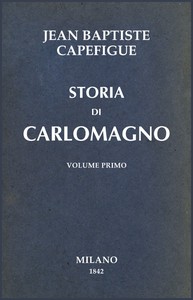
Storia di Carlomagno vol. 1/2 by M. Capefigue
Alright, let's set the scene. Europe in the 8th century is a messy patchwork of kingdoms, all fighting for power. Into this steps Charles, later known as Charlemagne, after the death of his father. He's co-ruling with his brother, but let's just say it's not a harmonious partnership. The first half of this volume is a masterclass in political survival. Capefigue walks us through how Charles navigates betrayal, secures his sole rule, and starts the grueling process of pulling his realm together.
The Story
The book kicks off with a kingdom in crisis. Charles isn't starting from a position of strength; he's putting out fires. The story follows his relentless campaigns to secure his borders, most famously his long, brutal wars against the Saxons. But it's not just about battles. Capefigue spends just as much time on the diplomacy, the alliances (and betrayals), and the internal reforms. We see Charles as a lawgiver and an administrator, trying to build something that will last. The volume builds toward his pivotal coronation as Emperor in Rome on Christmas Day, 800 AD, which wasn't a sudden reward but the culmination of decades of relentless effort.
Why You Should Read It
What hooked me was the human scale of the story. Capefigue, writing in the 19th century, has a knack for dramatic flair, but he grounds it in the details of governance and personality. You feel the weight of Charles's decisions. This isn't a statue on a horse; it's a man dealing with unreliable allies, religious complexities, and the constant challenge of feeding and controlling a vast army. You understand his achievements better because you see the sheer chaos he had to overcome. It makes the famous 'Carolingian Renaissance' feel less like a historical term and more like a hard-won victory.
Final Verdict
This is for you if you love epic historical biographies but want one that focuses on the gritty 'how' rather than just the glorious 'what.' It's perfect for readers of historical fiction who want to try the real story, or for anyone fascinated by how political power is built from the ground up. A heads-up: it's a 19th-century history, so the prose has a certain old-fashioned rhythm, but that's part of its charm. Think of it as a deep, compelling conversation with a very knowledgeable, slightly dramatic historian about one of the most pivotal figures who ever lived.
This digital edition is based on a public domain text. You can copy, modify, and distribute it freely.
Robert Wilson
5 months agoIt’s refreshing to see such a high standard of digital publishing.
Emily Johnson
10 months agoAs someone working in this industry, I found the insights very accurate.
Barbara King
9 months agoI had low expectations initially, however the clarity of the writing makes this accessible. Highly recommended.
Amanda Williams
1 year agoJust what I was looking for.







Sarah Williams
7 months agoA sophisticated analysis that fills a gap in the literature.