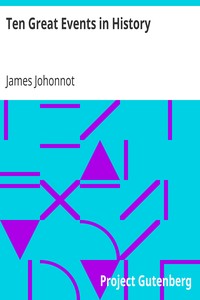
Ten Great Events in History by James Johonnot
Let's clear something up right away: this isn't a complete history of the world. James Johonnot, writing in the late 1800s, had a specific mission. He believed that to understand the present and prepare for the future, you needed to grasp a handful of pivotal moments that set everything else in motion. So, he chose ten.
The Story
The book walks us through these events in chronological order. It starts with the defense of Greece against Persian invasion at Marathon and Salamis, framing it as the struggle that saved Western ideals. It moves to the fall of Rome, not just as an empire collapsing, but as a shift that changed the map of Europe forever. We see the Magna Carta, where the idea that even a king was not above the law was forced into existence. The book covers the Crusades, the invention of the printing press, the discovery of America, the Protestant Reformation, the defeat of the Spanish Armada, and the settling of the American colonies, finishing with the American Revolution.
Johonnot doesn't just describe battles and signings. He sets the stage. He explains the tensions that were building, the key players involved, and most importantly, the direct consequences of each event. Why did the printing press matter more than any single war? How did a failed invasion (the Armada) lead to the rise of the British Empire? He connects the dots.
Why You Should Read It
What I love about this book is its focus on impact. It cuts through the noise and asks: 'What made this moment a game-changer?' Reading it feels like getting the highlights reel of human civilization, with expert commentary. It's also a fascinating look at how people in the 19th century viewed history. Their values and perspectives shine through, which is a history lesson in itself.
You won't get deep dives into daily life or minor characters. This is about the big picture. But in doing so, it creates a powerful framework. After reading it, every other history book or documentary you encounter will fit into a clearer, more meaningful timeline. You'll understand the foundational earthquakes that created the landscape we live on.
Final Verdict
This book is perfect for the curious reader who feels lost in the vastness of history and wants a solid, engaging starting point. It's for the fiction lover who enjoys a great story, because these are some of the greatest true stories ever told. It's also a gem for history buffs interested in historiography—seeing how our ancestors interpreted the past. Because of its age, some language and viewpoints are dated, but that adds to its charm and value as a historical artifact. Think of it less as the final word on these events, and more as the compelling, passionate introduction that makes you want to go learn more. A short, smart, and surprisingly lively classic.
This book is widely considered to be in the public domain. It is available for public use and education.
Ethan Thompson
7 months agoTo be perfectly clear, the author's voice is distinct and makes complex topics easy to digest. Definitely a 5-star read.
Richard Brown
5 months agoI stumbled upon this title and the clarity of the writing makes this accessible. One of the best books I've read this year.
Daniel Williams
9 months agoNot bad at all.
Jessica Moore
1 year agoVery helpful, thanks.
Ava Lewis
1 year agoComprehensive and well-researched.