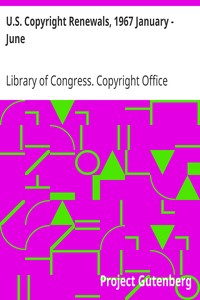
U.S. Copyright Renewals, 1967 January - June
Let's be clear upfront: U.S. Copyright Renewals, 1967 January - June is not a novel. There are no characters, no rising action, and definitely no climax. Published by the Library of Congress Copyright Office, it is exactly what the title promises: a formal listing of copyrights that were up for renewal during that six-month period. The 'plot' is the process itself. Copyrights originally lasted for 28 years, and to extend that protection for another term, the rights holder had to actively renew it. This book is the public record of who did that work.
The Story
Think of it as a massive check-in list for American creativity from 1939. As 1967 dawned, with the Vietnam War raging and the Summer of Love about to bloom, a deadline loomed for works published nearly three decades prior. This volume logs the results. You'll find entries for novels, songbooks, technical manuals, cartoons, and plays. Each line is a data point: a title, an author, a registration number. The 'story' is in the patterns and the absences. What kinds of works from the pre-war world were still considered valuable assets? What faded away because no one bothered to renew? The narrative is one of cultural curation, written not by critics but by lawyers and heirs.
Why You Should Read It
I find this book strangely moving. It turns intellectual property into a human gesture. Every renewal is a vote of confidence from the past. That obscure pulp novel? Someone believed it still had life. That old songbook? A composer or their family saw future value in it. It's a reminder that our cultural heritage isn't just made in the brilliant moment of creation; it's also maintained through unglamorous, diligent effort. Flipping through it, you start playing detective. You see a familiar title and think, 'Ah, so that was still kicking around in '67.' It connects two very different eras of America through the simple thread of paperwork.
Final Verdict
This is not a book you read cover-to-cover. It's a reference work, a tool for researchers, and a fascinating artifact for a very specific kind of nerd. It's perfect for historians, copyright scholars, or authors tracking the status of older works. But it's also for the deeply curious reader who loves primary sources and finding stories in unexpected places. If you've ever fallen down a Wikipedia rabbit hole or spent hours on archival websites, you might just get a kick out of this. It's a quiet, powerful look at the machinery of memory, proving that sometimes, the driest texts can hold the most interesting ghosts.
This work has been identified as being free of known copyright restrictions. Knowledge should be free and accessible.
Patricia Anderson
10 months agoAs a long-time follower of this subject matter, the nuanced approach to the central theme was better than I expected. Truly a masterpiece of digital educational material.
Aiden Clark
11 months agoMy professor recommended this, and I see why.
Aiden Moore
9 months agoTo be perfectly clear, the clarity of the writing makes this accessible. Definitely a 5-star read.
Melissa Scott
1 year agoCitation worthy content.

Donald Moore
1 year agoI took detailed notes while reading through the chapters and the emphasis on ethics and sustainability within the topic is commendable. A refreshing and intellectually stimulating read.