About 27 minutes
A Christmas Sermon — Reading Notes
Science Fiction Utopias
6,079 recorded words. 13 minutes difference from this book's estimate.
View Gutenberg source #14535
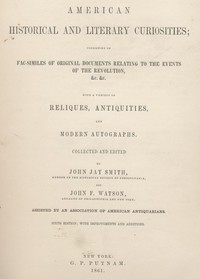
Before opening American Historical and Literary Curiosities, Part 02 — Reading Notes, the edition data offers a quick orientation: 3,101 words, 14 min estimated reading time, and 1 detected text section.
The text analysis averages about 25.0 words per sentence, while the detected sections provide another way to judge how the source is divided.
Project Gutenberg metadata also associates the work with “United States -- History -- Revolution, 1775-1783 -- Sources,” connecting these edition facts with the source record’s subject description.
Explore this collection
These alternatives are selected using recorded categories and estimated reading time.
About 27 minutes
Science Fiction Utopias
6,079 recorded words. 13 minutes difference from this book's estimate.
View Gutenberg source #14535About 42 minutes
Science Fiction Utopias
9,488 recorded words. 28 minutes difference from this book's estimate.
View Gutenberg source #3426About 53 minutes
Science Fiction Utopias
12,045 recorded words. 39 minutes difference from this book's estimate.
View Gutenberg source #7409Search stored excerpts and compare books → Choose by your preferences →
Choices use stored catalog measurements. Estimates vary with reading speed. A shared category is a catalog label, not a claim that two books have the same argument or literary quality.
Search reads excerpt text stored with this catalog and links to its associated Gutenberg record. The connection is stored in the site database; this tool does not recheck that every excerpt is word-for-word identical to that external record. Excerpt search does not cover every chapter and does not verify historical publication dates.
Catalog snapshot checked: 2026-09-26. Coverage: 96 public books, 96 available source excerpts.
Calculated from edition completeness, EPUB availability, text structure and catalogue metadata. Not a user rating.
Total of 100 points, scaled to a 2.5-5.0 range. Editions with an empty description or a missing EPUB file are not scored.
Public-domain source text
The source text is kept in the dedicated reader, separate from this catalogue record and its commentary.
Part 2 of American Historical and Literary Curiosities presents a sequence of plates—numbered 8 through 14—that reproduce autographs and documents from the Revolutionary period. The work’s structure is skeletal: a list of plate numbers followed by the plates themselves, with no intervening commentary. This spare organization forces the reader to attend to the visual evidence directly, without narrative mediation. The recurring image of the signature—reproduced as facsimile—becomes the primary unit of meaning, shifting attention from textual content to the material trace of the hand.
The seven plates in this part are introduced only by their numbers, creating a rhythm of anticipation and encounter. Each plate functions as a self-contained artifact, yet the sequence implies a curatorial logic: the plates move from one document to the next without explicit transition. This structure mirrors the experience of leafing through a physical portfolio, where the reader’s eye moves from one facsimile to another, constructing connections through juxtaposition rather than explanation. The absence of captions or headnotes within the plate list underscores the primacy of the visual object over textual framing.
Across the plates, the autograph emerges as a repeated visual motif. Each signature is rendered in facsimile, preserving the idiosyncrasies of penmanship—the slant, the pressure, the flourishes. These handwritten marks are not merely documentary evidence but also aesthetic objects, inviting scrutiny of their form. The recurrence of the autograph across different documents creates a visual rhythm, linking disparate texts through the common act of signing. The reader is encouraged to compare the hands of different figures, noting variations in script that hint at personality or circumstance.
The transition from one plate to the next enacts a movement across time and space. A commission, a letter, a military order—each document carries its own context, yet the sequence blurs these boundaries. The reader moves from a formal document to a personal note, from a public proclamation to a private correspondence, without explanatory bridges. This abrupt juxtaposition highlights the heterogeneity of Revolutionary-era writing, forcing the reader to infer connections. The structure thus becomes a tool for active interpretation, requiring the reader to supply the missing narrative links.
The facsimiles present historical evidence in a raw, unmediated form. Without editorial gloss, the reader must rely on visual cues—the layout of the page, the presence of seals, the spacing of lines—to assess the document’s function and provenance. The recurring image of the signature anchors this process, serving as a point of stability amid the variety of document types. Yet the excerpts provide no context for individual plates, so inferences about authorship or occasion remain tentative. The work’s structure thus foregrounds the act of looking itself, making the reader a participant in the reconstruction of history.
Readers approaching Part 2 should attend to the sequence of plates as a deliberate arrangement, not a random assortment. The movement from one facsimile to the next invites comparison and contrast, while the recurring autograph motif ties the collection together. By focusing on the visual properties of the documents—the handwriting, the layout, the material traces—one can engage with the Revolutionary period through a lens that prioritizes evidence over narrative.
The rain drummed a slow rhythm on the window as I traced the facsimiles in Part 02, those faded ink strokes of Revolutionary fervor. Somehow, the hushed intimacy of reading someone’s annotations made me crave a closer look at the act of understanding itself. Later, my fingers found A Book of Exposition — A Closer Reading on the shelf, and the afternoon's quiet puzzle simply continued.
Create a short personal record of your experience with this book.