About 188 minutes
Portraits and Speculations — Reading Notes
Science Fiction Utopias
43,096 recorded words. 4 minutes difference from this book's estimate.
View Gutenberg source #65992
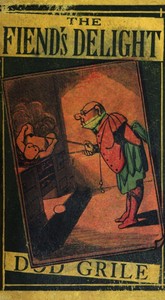
The Fiend's Delight — Context and Discussion can be approached with a clearer sense of reading commitment from its source measurements: 42,173 words, 3 hr 4 min estimated reading time, and 73 detected text sections.
The text analysis averages about 22.3 words per sentence, while the detected sections provide another way to judge how the source is divided.
Project Gutenberg metadata also associates the work with “American wit and humor,” connecting these edition facts with the source record’s subject description.
Explore this collection
These alternatives are selected using recorded categories and estimated reading time.
About 188 minutes
Science Fiction Utopias
43,096 recorded words. 4 minutes difference from this book's estimate.
View Gutenberg source #65992About 179 minutes
Science Fiction Utopias
41,067 recorded words. 5 minutes difference from this book's estimate.
View Gutenberg source #13910About 175 minutes
Science Fiction Utopias
40,048 recorded words. 9 minutes difference from this book's estimate.
View Gutenberg source #9371Search stored excerpts and compare books → Choose by your preferences →
Choices use stored catalog measurements. Estimates vary with reading speed. A shared category is a catalog label, not a claim that two books have the same argument or literary quality.
Search reads excerpt text stored with this catalog and links to its associated Gutenberg record. The connection is stored in the site database; this tool does not recheck that every excerpt is word-for-word identical to that external record. Excerpt search does not cover every chapter and does not verify historical publication dates.
Catalog snapshot checked: 2026-09-26. Coverage: 96 public books, 96 available source excerpts.
Calculated from edition completeness, EPUB availability, text structure and catalogue metadata. Not a user rating.
Total of 100 points, scaled to a 2.5-5.0 range. Editions with an empty description or a missing EPUB file are not scored.
Public-domain source text
The source text is kept in the dedicated reader, separate from this catalogue record and its commentary.
The Fiend's Delight, published in 1873 under the pseudonym Dod Grile, opens with a preface that sets a deliberately provocative tone. Bierce describes the collection as a "cold collation of diabolisms" drawn from California journals, crediting his "scholarly friend Mr. Satan" as collaborator. The dedication to the goddess Good Taste—for her condemnation of superior authors—signals the irreverent stance that pervades the work.
The excerpts reveal a writer who treats violence, religion, and social conventions with equal mockery. In one sketch, horses deliberately kick pedestrians; in another, a gymnasium for pious young women becomes a scene of contortion and absurd piety. Bierce's narrator often adopts a persona of cheerful malice, praising what others condemn and condemning what others praise.
The preface establishes a framing device that colors the entire collection. Bierce claims Mr. Satan as his assistant, attributing "most of the views herein set forth" to this worthy gentleman. This is not mere whimsy: it allows the author to voice opinions that would be unacceptable if stated in his own person. The dedication to Good Taste—thanked for condemning superior authors—further undercuts conventional literary values.
This satirical strategy appears throughout the excerpts. When the narrator defends nursing bottles made with lead and antimony, arguing that these substances are "nutritious and essential" to a child's growth, he parodies both scientific alarmism and parental credulity. The mock-serious tone, complete with a fabricated infant voice demanding "oxysulphuret of antimony," shows Bierce's method: taking a position so extreme that it exposes the absurdity of the original argument.
Physical harm recurs as a source of humor in these sketches. The horses that "take a fiendish delight" in kicking pedestrians are described with a straight-faced analysis of their tactics: feigning sleep, then discharging their feet "without a preliminary yawn." The narrator notes that the damage is "merely nominal" when the victim is a "worthless Italian fisherman, market gardener, or decayed gentleman."
This casual cruelty extends to the preface's boast: "I think I have killed a good many people in one way or another; but the reader will please to observe that they were not people worth the trouble of leaving alive." The humor depends on the reader recognizing the gap between the narrator's callousness and ordinary human sympathy. Bierce does not soften the blow with euphemism; he sharpens it.
One extended excerpt describes a gymnasium in a San Francisco temple where young women perform acrobatic feats. The narrator names them with biblical resonance—Rachel, Ruth, Hannah, Mehitable Ann, Jerusha—and describes their exercises in language that blends religious devotion with physical absurdity. Jerusha "ties herself in a double bow-knot, and meditates upon the doctrine of election."
The passage culminates in a mock-ecstatic outburst: "O, blessed temple of grace divine! O, innocence and youth and simple faith! O, water and molasses and unsalted butter!" The juxtaposition of sacred and mundane—"niceness absolute and godly whey"—reveals Bierce's technique of deflating piety by treating it as a physical performance. The narrator wishes he were "female, and Christian, and immature" so he could "contort and musculate with much satisfaction of soul."
Readers approaching The Fiend's Delight should expect a work that consistently undermines earnestness. Bierce's persona as Dod Grile allows him to praise what is normally condemned and condemn what is normally praised, creating a sustained ironic distance. The collection's structure—mixing fiction, tall talk, obituaries, and verse—reflects its origins in periodical publication. Each piece rewards attention to the specific targets of its mockery, which range from religious enthusiasm to scientific alarmism to the casual violence of urban life.
I kept thinking about how Bierce’s wicked little sketches follow you like a shadow, laughing at everything we take seriously. It reminded me of something quieter—a walking anthology that lets you step outside your own head for a while. The Footpath Way: An Anthology for Walkers — Edition Insights felt like that kind of company, unhurried and strangely warm.
Your answers remain private and are stored only in this browser.