About 184 minutes
The Fiend's Delight — Context and Discussion
Science Fiction Utopias
42,173 recorded words. 4 minutes difference from this book's estimate.
View Gutenberg source #4793
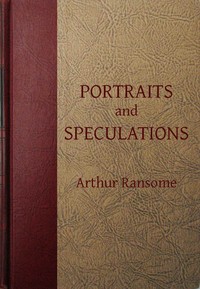
Portraits and Speculations — Reading Notes can be approached with a clearer sense of reading commitment from its source measurements: 43,096 words, 3 hr 8 min estimated reading time, and 16 detected text sections.
The text analysis averages about 25.5 words per sentence, while the detected sections provide another way to judge how the source is divided.
Project Gutenberg metadata also associates the work with “Literature, Modern -- 19th century -- History and criticism,” connecting these edition facts with the source record’s subject description.
Explore this collection
These alternatives are selected using recorded categories and estimated reading time.
About 184 minutes
Science Fiction Utopias
42,173 recorded words. 4 minutes difference from this book's estimate.
View Gutenberg source #4793About 179 minutes
Science Fiction Utopias
41,067 recorded words. 9 minutes difference from this book's estimate.
View Gutenberg source #13910About 175 minutes
Science Fiction Utopias
40,048 recorded words. 13 minutes difference from this book's estimate.
View Gutenberg source #9371Search stored excerpts and compare books → Choose by your preferences →
Choices use stored catalog measurements. Estimates vary with reading speed. A shared category is a catalog label, not a claim that two books have the same argument or literary quality.
Search reads excerpt text stored with this catalog and links to its associated Gutenberg record. The connection is stored in the site database; this tool does not recheck that every excerpt is word-for-word identical to that external record. Excerpt search does not cover every chapter and does not verify historical publication dates.
Catalog snapshot checked: 2026-09-26. Coverage: 96 public books, 96 available source excerpts.
Calculated from edition completeness, EPUB availability, text structure and catalogue metadata. Not a user rating.
Total of 100 points, scaled to a 2.5-5.0 range. Editions with an empty description or a missing EPUB file are not scored.
Public-domain source text
The source text is kept in the dedicated reader, separate from this catalogue record and its commentary.
Arthur Ransome opens his 1913 collection Portraits and Speculations by taking direct aim at the doctrine of art for art's sake, a theory he finds limiting rather than glorifying. He traces its lineage through Baudelaire, Whistler, Rossetti, Pater, and Wilde, quoting Baudelaire's claim that poetry 'has no other end than itself.' Ransome's own prose is pointed: he calls Whistler 'that butterfly of letters, who had borrowed his sting from the wasp.' This early essay sets the tone for a volume that scrutinizes writers through their linguistic and structural choices, not through biographical gossip or abstract praise.
In his essay on Friedrich Nietzsche, Ransome avoids the usual biographical reduction of madness to explanation. Instead, he focuses on Nietzsche's prose style, describing it as 'now hammer-welded, now silver filigree, dancing, walking, running in time with his ideas and moods.' This attention to rhythm and texture is typical of Ransome's method. He compares Nietzsche's mental collapse to an engine that 'races' and breaks its crankshaft, a mechanical metaphor that refuses mystification. Ransome insists that Nietzsche's work should be judged by its psychological subtlety, placing his aphorisms alongside La Rochefoucauld and Stendhal. The essay argues that Nietzsche's 'Will to Power' and 'Superman' are secondary to his observations on friendship and self-development—a claim that reorients the reader toward the writer's craft rather than his notoriety.
Ransome portrays Nietzsche's method as a kind of alchemical experiment: applying his core ideas—Will to Power, Slave Morality—to a wide range of statements and watching them 'turn truisms into popular fallacies.' This is not systematic philosophy but a 'continual endless application' that Ransome likens to a Sisyphean task. He notes that Nietzsche's books became 'corrections of Pseudodoxia,' a term that echoes Sir Thomas Browne. The essay's diction is precise: Ransome speaks of 'vivid summer lightning' and 'sedate erection of a system' to contrast Nietzsche's frenzied creativity with more orderly thinkers. By emphasizing the writer's intellectual speed and the resulting 'catastrophe,' Ransome makes a case for reading Nietzsche as a psychologist and moralist first, a philosopher of ideas second.
The essays on Alphonse Daudet and François Coppée, originally prefixed to collections of their stories, show Ransome's interest in how writers shape narrative through diction and dialogue. He examines Daudet's use of sensory detail and regional voice, noting how the author's Provençal background inflects his descriptions. For Coppée, Ransome focuses on the 'retrospection' that gives his essay its title—a tendency to look backward that colors both the characters' speech and the narrator's tone. Ransome avoids plot summary, instead isolating moments where a character's word choice or a descriptive phrase reveals the author's larger design. These essays are less speculative than the Nietzsche piece, but they demonstrate Ransome's consistent method: close reading of verbal texture to uncover the writer's implicit theory of art.
The final essay, 'Kinetic and Potential Speech,' is the most explicitly theoretical in the collection. Ransome distinguishes between language that is active, moving, and charged with energy ('kinetic') and language that is static, latent, awaiting activation ('potential'). This binary is not merely a stylistic observation; it underpins his entire critical approach. He argues that great writers harness both modes, shifting between them to control pace and emphasis. The essay draws on examples from the poets and novelists discussed earlier, but Ransome does not name them here, instead building a general framework. The terminology—borrowed from physics—reflects his desire to treat literature with analytical precision. This piece serves as a capstone, making explicit the principles that guided the preceding portraits.
Ransome's Portraits and Speculations rewards readers who attend to the grain of his prose as closely as he attends to his subjects'. His metaphors—engines, alchemy, kinetic energy—are not decorative but functional, each one chosen to illuminate a writer's method. The collection is best approached as a series of demonstrations: watch how Ransome builds an argument from a single phrase or a rhythmic pattern, and you will see how he believes criticism should work.
I remember Ransome’s gentle insistence that a writer’s true voice hides in their smallest choices. It made me think of that other volume, The new art of writing plays — Background and Themes, and how both books whisper the same secret: craft is just attention, patiently kept. They sit apart on my shelf, yet share a quiet breath.
A brief reflection can help important ideas stay with you longer.