About 55 minutes
On the Duty of Civil Disobedience — Edition Insights
Science Fiction Utopias
12,566 recorded words. 1 minutes difference from this book's estimate.
View Gutenberg source #71
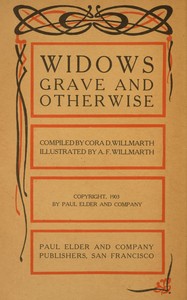
Widows grave and otherwise — Reading Notes can be approached with a clearer sense of reading commitment from its source measurements: 12,264 words, 54 min estimated reading time, and 4 detected text sections.
The text analysis averages about 16.7 words per sentence, while the detected sections provide another way to judge how the source is divided.
Project Gutenberg metadata also associates the work with “Quotations,” connecting these edition facts with the source record’s subject description.
Explore this collection
These alternatives are selected using recorded categories and estimated reading time.
About 55 minutes
Science Fiction Utopias
12,566 recorded words. 1 minutes difference from this book's estimate.
View Gutenberg source #71About 53 minutes
Science Fiction Utopias
12,045 recorded words. 1 minutes difference from this book's estimate.
View Gutenberg source #7409About 61 minutes
Science Fiction Utopias
13,953 recorded words. 7 minutes difference from this book's estimate.
View Gutenberg source #76719Search stored excerpts and compare books → Choose by your preferences →
Choices use stored catalog measurements. Estimates vary with reading speed. A shared category is a catalog label, not a claim that two books have the same argument or literary quality.
Search reads excerpt text stored with this catalog and links to its associated Gutenberg record. The connection is stored in the site database; this tool does not recheck that every excerpt is word-for-word identical to that external record. Excerpt search does not cover every chapter and does not verify historical publication dates.
Catalog snapshot checked: 2026-09-26. Coverage: 96 public books, 96 available source excerpts.
Calculated from edition completeness, EPUB availability, text structure and catalogue metadata. Not a user rating.
Total of 100 points, scaled to a 2.5-5.0 range. Editions with an empty description or a missing EPUB file are not scored.
Public-domain source text
The source text is kept in the dedicated reader, separate from this catalogue record and its commentary.
The first entry, dated January First, declares that “Widows, like ripe fruit, drop easily from their perch,” a metaphor that sets the tone for the entire collection: witty, slightly cynical, and grounded in worldly observation. The compiler, Cora D. Willmarth, signals her editorial stance in the playful subtitle—“Purloined by an Ex-Widow and Pictured by a Victim”—and the epigraph from Dickens, “Widders are ’ceptions to ev’ry rule.” The book is structured as a calendar, with one or more quotations assigned to each day of the year, from January First to December Thirty-First. This format invites browsing rather than consecutive reading, and the excerpts range from Shakespearean soliloquies to newspaper jokes, from Dutch proverbs to lines by Dorothy Dix. The opening pages immediately establish that widowhood is treated as a subject for both humor and shrewd social commentary, not for solemn reflection.
The calendar structure imposes a rhythm of daily aphorisms, but the entries are not evenly distributed. Some days, like January Fourth, carry a single weighty quotation—Shakespeare’s “Frailty, thy name is woman!”—while others, like August Sixteenth, pair two short items. The effect is a mosaic of voices: Addison appears repeatedly, often with dry observations about widows’ quick remarriages; Chapman contributes a recurring note of suspicion, as in “Widows are such a subtle generation of people they may be left to their own conduct.” Dorothy Dix, a pseudonymous columnist, supplies some of the sharpest modern-sounding lines, such as “The widow knows man as merely a fallible human institution and she works him for all that he is worth.” The calendar format also allows for thematic clustering: August, for instance, is dense with warnings about widows’ romantic power, while earlier months mix proverbs and literary allusions.
Many quotations assume a male speaker addressing other men, as in the Dutch proverb “To marry once is a duty, twice a folly, thrice is madness,” or Mr. Dooley’s comic confession about dodging “the widow Grogan.” Yet female perspectives occasionally surface, often filtered through male writers. The entry for August Twenty-Fifth—“No man is a romantic hero to a widow”—is unattributed but echoes the pragmatic tone of Dorothy Dix. A few entries, like the one from Life magazine on August Seventh, depict widows as calculating: “The widow about to remarry is the most unselfish of mortals. She seldom thinks of number one.” The collection also includes biblical and literary references, such as Revelation 18:7 (“For she saith in her heart, I sit a queen, and am no widow”), which adds a layer of ironic contrast to the worldly maxims. The overall effect is a chorus of voices that rarely agree, leaving the reader to weigh competing views.
Certain images recur across the calendar. Widows’ weeds—the black garments of mourning—appear in several entries, notably in Addison’s quip that “Her weeds have served her twice and are still as good as new.” Tears are another motif, often described as short-lived or insincere: Chapman writes of “widows’ tears” as “laughing under a mask,” and a later entry from The Wasp jokes about a widow who needs “a month to get ready” after her year of mourning ends. Second marriage is the most persistent theme, treated alternately as a folly, a necessity, or a predatory act. The entry for August Tenth quotes Byron on preferring a husband “in the plural number,” while a line from Life on August Twentieth calls the remarrying widow “the most unselfish of mortals.” These recurring motifs create a coherent set of concerns even as the individual voices diverge.
Cora D. Willmarth identifies herself as an “Ex-Widow” in the subtitle, a detail that frames the collection as insider commentary. The illustrator, A. F. Willmarth, is credited as “a Victim,” suggesting a male perspective. The interplay between compiler and illustrator is not elaborated in the excerpts, but the visual element likely reinforces the satirical tone. The book’s original publisher, Paul Elder and Company of San Francisco, issued it in 1903, a period when quotation anthologies were popular. The selection of authors—Shakespeare, Dickens, Addison, Kipling, Dorothy Dix—reflects a blend of canonical and contemporary sources. The compiler’s choices emphasize wit over sentiment, and the calendar structure imposes a kind of order on what might otherwise seem a random assortment. Readers should note that the excerpts are not attributed to specific works, only to authors, which sometimes obscures context.
This collection rewards dipping in at any date, but reading sequentially reveals how the same themes recur with variations. The entries are best approached as conversation starters rather than definitive statements; the compiler’s own position as an “Ex-Widow” invites readers to consider the gap between the quoted voices and her implied experience. Pay attention to the sources: the mix of literary heavyweights and ephemeral journalism tells us something about early twentieth-century attitudes toward widowhood. The book is a period piece, but its sharp observations still land.
I recall the 1903 datebook, Widows Grave and Otherwise, its pages rustling with a curious tenderness for those left behind—satire resting beside sympathy like old gloves in a drawer. A similar whisper lives in the quiet arithmetic of Reflections on the Decline of Science in England, and on Some of Its Causes — Themes and Context, where loss is measured not in years but in forgotten rigor. Both books mourn, gently.
Capture what you thought, learned, and would like to remember.