About 246 minutes
Miscellanies Upon Various Subjects — Reading Notes
Fantasy Juvenile Worlds
56,555 recorded words. 4 minutes difference from this book's estimate.
View Gutenberg source #4254
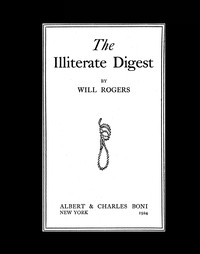
The source record for The Illiterate Digest — Story, Setting & Ideas measures this digital text at 55,546 words, 4 hr 2 min estimated reading time, and 43 detected text sections.
The text analysis averages about 19.2 words per sentence, while the detected sections provide another way to judge how the source is divided.
Project Gutenberg metadata also associates the work with “American wit and humor,” connecting these edition facts with the source record’s subject description.
Explore this collection
These alternatives are selected using recorded categories and estimated reading time.
About 246 minutes
Fantasy Juvenile Worlds
56,555 recorded words. 4 minutes difference from this book's estimate.
View Gutenberg source #4254About 215 minutes
Fantasy Juvenile Worlds
49,448 recorded words. 27 minutes difference from this book's estimate.
View Gutenberg source #9595About 211 minutes
Fantasy Juvenile Worlds
48,312 recorded words. 31 minutes difference from this book's estimate.
View Gutenberg source #4904Search stored excerpts and compare books → Choose by your preferences →
Choices use stored catalog measurements. Estimates vary with reading speed. A shared category is a catalog label, not a claim that two books have the same argument or literary quality.
Search reads excerpt text stored with this catalog and links to its associated Gutenberg record. The connection is stored in the site database; this tool does not recheck that every excerpt is word-for-word identical to that external record. Excerpt search does not cover every chapter and does not verify historical publication dates.
Catalog snapshot checked: 2026-09-26. Coverage: 96 public books, 96 available source excerpts.
Calculated from edition completeness, EPUB availability, text structure and catalogue metadata. Not a user rating.
Total of 100 points, scaled to a 2.5-5.0 range. Editions with an empty description or a missing EPUB file are not scored.
Public-domain source text
The source text is kept in the dedicated reader, separate from this catalogue record and its commentary.
Will Rogers opens The Illiterate Digest with a letter from a lawyer representing Funk & Wagnalls, publishers of the Literary Digest, threatening legal action over Rogers's use of the phrase “Illiterate Digest” for a film series. Rogers prints the lawyer's letter verbatim, then his own reply—a tactic that immediately establishes the book's combative, self-deprecating tone. The title, he explains, was never meant to mock the Literary Digest but to describe his own haphazard method of collecting sayings. This opening gambit reveals Rogers's willingness to turn a legal threat into comic material, and it sets up a pattern: the book will treat officialdom, civic ceremonies, and media with the same irreverent scrutiny.
The inclusion of the full legal correspondence is not mere padding. Rogers lets the lawyer's stiff, formal prose—phrases like “the consequence of which may have escaped your consideration”—stand in stark contrast to his own colloquial voice. By reproducing the letter without comment, he allows readers to see the absurdity of a publisher claiming that a comedian's film title could “lower” the prestige of a weekly magazine. Rogers's reply, printed immediately after, is a model of folksy deflection: he claims ignorance, promises to change the title, and then, in a postscript, asks if he can use “Literary Digest” instead. The exchange functions as a microcosm of the book's method: take a serious or bureaucratic situation, expose its pomposity through direct quotation, and undercut it with a joke that lands on the side of common sense.
In a later excerpt, Rogers launches a sustained attack on parades and outdoor speaking events. He describes towns competing to assemble ever-larger human flags, forcing children to stand in the hot sun for hours. His remedy is characteristically practical: set aside one street for parades, and let no one watch. “The minute a Parader sees that no one is watching him he will stop,” he writes. The humor derives from his deadpan enumeration of grievances—parades “stop more work, inconvenience more People, stop more traffic, cause more accidents”—and his refusal to grant them any ceremonial dignity. He extends the critique to stadiums, which he calls “60 acre Fields” where a speaker's voice is ruined. The passage is notable for its specific, almost bureaucratic catalog of complaints, a style that recurs throughout the book.
Rogers recounts serving on a reception committee for President Harding's visit to Los Angeles. The committee, he says, decided to take the President to every movie studio to avoid showing partiality, thereby consuming his entire schedule. Rogers's punchline—“Can you imagine being a Guest of the City of Carnegie, Pa., and the Committee showing you through all the Steel mills in Town?”—hinges on a comparison that deflates the movie industry's self-importance. He notes that Harding was allowed only fifteen minutes to visit an aunt, his only relaxation, and that golf, his preferred recreation, was squeezed out. The anecdote is less about Harding than about the absurd logic of committees: they act out of fear of favoritism, producing outcomes that serve no one. Rogers's voice here is that of a practical man bewildered by institutional nonsense.
Readers approaching The Illiterate Digest should expect a collection that moves between set pieces like the lawyer's letter and longer comic essays on American customs. Rogers's persona—the plainspoken cowboy who sees through pretension—is consistent, but the targets vary: civic boosters, the film industry, politicians, and the press. The excerpts suggest that the book's humor depends on specific, often dated references (Harding's 1923 tour, the Literary Digest), but its method of exposing institutional folly through concrete detail remains legible.
That rainy afternoon, Will Rogers’s Illiterate Digest made me laugh at all the fussy rituals people build around themselves. His plain talk felt like a friend’s voice. Later, I found myself thinking about how alike we all are underneath the ceremony, and reached for Bunyan Characters (1st Series) — Story, Setting & Ideas, expecting something heavier—but it simply kept that same quiet, human thread going.
Use these questions to collect your thoughts before moving on.