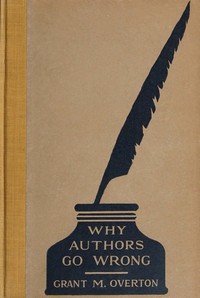
Grant M. Overton opens his 1919 collection with a characteristically self-aware gambit: the title essay, 'Why Authors Go Wrong,' begins by deferring its own subject, suggesting that a full answer would require a separate book. This rhetorical move sets the tone for a volume that is less a systematic treatise than a series of candid, often ironic reflections on the literary profession. Overton, a literary editor and author, draws on his own experience to dissect the relationships between writers, publishers, critics, and readers.
The catalog subjects list 'Authorship' and 'philosophy-ethics,' but the excerpts reveal a work more concerned with practical realities than abstract principles. Overton's focus is on the mechanics of the book trade—how reviews are written, how publishers calculate risk, and how literary editors balance integrity with commercial pressures. The ethical dimension emerges not as moralizing but as a byproduct of his analysis of institutional conflicts of interest.
The Literary Editor's Balancing Act
In the chapter 'Literary Editors, by One of Them,' Overton offers a pragmatic defense of the literary editor's relationship with advertising. He argues that a book page without advertising is 'lopsided' and that readers 'resent it, and rightly.' This is not a cynical capitulation to commerce; rather, Overton insists that an editor's interest in advertising 'has and can have no relation to his editorial or news policy.' He illustrates this with a hypothetical scenario involving the fictional firms Bing, Bang & Company and Puff & Boom, asserting that an editor may give a front-page review to a best seller from a non-advertiser while declining to lunch with its executives. The key, he writes, is that editorial decisions must be 'determined by their news value alone.'
Overton's tone is conversational and slightly sardonic, as when he notes that 'any one who can be human successfully can do the far lesser thing much better than any literary editor has yet done it.' This blend of idealism and realism characterizes his approach throughout the book.
Publishing as Speculation
In 'What Every Publisher Knows,' Overton compares book publishing to the theatrical business, calling it 'a highly speculative enterprise and hardly a business at all.' He lists its traits: 'Full of risks. Requiring, unless genius is manifested, considerable money capital. Likely to make, and far more likely to lose, small fortunes overnight.' The analogy extends to the emotional toll: publishing is 'Fatally fascinating. More an art than an organization but usually requiring an organization for the exhibition of the most brilliant art—like opera. A habit comparable with hasheesh. Heart-lifting—and headachy.'
Overton's own position as an 'amateur recording impressions extending a little over a year' lends the chapter a confessional quality. He acknowledges his limited experience but uses it to frame his observations as those of an insider-outsider. The chapter's central claim—that 'general' publishing is not a stable business—is supported by anecdotal evidence rather than data, reflecting the essay's roots in personal observation rather than systematic research.
The Ethics of Book Reviewing
Overton's chapter 'Book “Reviewing”' (the scare quotes are his) tackles the tension between critical independence and commercial pressure. He argues that a literary editor's interest in book advertising 'need no more be limited than the interest he takes in the growth or improvement of any other feature of his page.' Yet he also warns that 'an alliance between the pen and the pocketbook is known the moment it is made and is transparent the moment it takes effect in print.' This paradox—that advertising can coexist with editorial integrity if handled properly—is central to Overton's vision of the literary marketplace.
He offers a concrete example: a publisher who advertises heavily may still have books that are 'one-stick stories' (i.e., of little substance), and the editor's duty is to judge them on merit. Overton's language is blunt: 'It’s a beautiful façade, but the side view is disappointing.' The chapter does not resolve the ethical dilemma but instead presents it as an ongoing negotiation, reflecting the messy reality of early twentieth-century publishing.
Overton's essays are best read as period documents that illuminate the anxieties and aspirations of the literary world a century ago. Readers interested in the history of publishing will find his insider perspective valuable, though they should note that his claims are based on personal experience rather than comprehensive data. The book's strength lies in its concrete details—the hypothetical Bing, Bang & Company, the comparison of publishing to hasheesh—rather than in its general theories. Approach it as a series of candid conversations with a seasoned editor, not as a definitive guide.
Overton’s old volume left me thinking about how writers stumble, not for lack of craft, but for want of quiet nerve. That same patient honesty lingers in Cock Lane and Common-Sense — Reading Notes, where the supernatural meets plain reasoning. Both feel like murmured asides, the kind you’d jot down reading late, lamp low, pages smelling of dust.