About 292 minutes
Robert Louis Stevenson: A Record, an Estimate, and a Memorial — Background and Themes
Fantasy Juvenile Worlds
67,033 recorded words. 11 minutes difference from this book's estimate.
View Gutenberg source #590
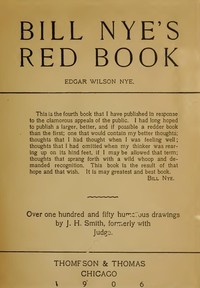
This digital edition of Bill Nye's Red Book New Edition — Context and Discussion is described by source-level measurements including 64,486 words, 4 hr 41 min estimated reading time, and 10 detected text sections.
The text analysis averages about 21.0 words per sentence, while the detected sections provide another way to judge how the source is divided.
Project Gutenberg metadata also associates the work with “American wit and humor,” connecting these edition facts with the source record’s subject description.
Explore this collection
These alternatives are selected using recorded categories and estimated reading time.
About 292 minutes
Fantasy Juvenile Worlds
67,033 recorded words. 11 minutes difference from this book's estimate.
View Gutenberg source #590About 246 minutes
Fantasy Juvenile Worlds
56,555 recorded words. 35 minutes difference from this book's estimate.
View Gutenberg source #4254About 242 minutes
Fantasy Juvenile Worlds
55,546 recorded words. 39 minutes difference from this book's estimate.
View Gutenberg source #72717Search stored excerpts and compare books → Choose by your preferences →
Choices use stored catalog measurements. Estimates vary with reading speed. A shared category is a catalog label, not a claim that two books have the same argument or literary quality.
Search reads excerpt text stored with this catalog and links to its associated Gutenberg record. The connection is stored in the site database; this tool does not recheck that every excerpt is word-for-word identical to that external record. Excerpt search does not cover every chapter and does not verify historical publication dates.
Catalog snapshot checked: 2026-09-26. Coverage: 96 public books, 96 available source excerpts.
Calculated from edition completeness, EPUB availability, text structure and catalogue metadata. Not a user rating.
Total of 100 points, scaled to a 2.5-5.0 range. Editions with an empty description or a missing EPUB file are not scored.
Public-domain source text
The source text is kept in the dedicated reader, separate from this catalogue record and its commentary.
Bill Nye opens his fourth book with a mock-serious preface that sets the tone for the entire collection. He claims to have selected only his best thoughts—those thought while his 'thinker was rearing up on its hind feet'—and boasts that the book will 'live for weeks after other books have passed away.' The humor lies in the deadpan inflation of his own importance, as he describes the book as a 'universal repository of thought' that can also be used to 'kill a cockroach.' This self-aware absurdity is the engine of the work.
Nye's preface is not a straightforward introduction but a comic routine. He explains that he published this book only after the public's 'clamorous appeals' became too loud to ignore, and he notes that his earlier volumes were 'greedily snapped up' by 'tottering dynasties' under international copyright. The humor depends on the reader recognizing the exaggeration: Nye presents himself as a reluctant celebrity whose every thought is a public treasure. He also warns that the book is 'not so large as I had intended' because he removed substandard material, comparing the shrinkage to 'the bank book of an outspoken clergyman.' The preface thus establishes a persona—a humorist who takes himself just seriously enough to be funny.
In the excerpt on temperance and cider-making, Nye adopts the voice of a reformer praising a non-alcoholic beer. He claims the beer is 'non-intoxicating' because drinkers would die of stomach perforation before getting drunk. The satire targets both the temperance movement and the manufacturers of dubious substitutes. He then turns to a pamphlet on winning 'the affections of the opposite sex at sixty yards,' mocking the idea that romance can be reduced to a twenty-five-cent manual. Nye's narrator claims to have 'groped' without such a book and prefers to continue groping, undercutting the very advice he pretends to endorse. These passages show Nye's skill at ventriloquizing earnest voices to expose their absurdity.
The excerpt about sawing wood offers a glimpse into Nye's narrative style. He recalls earning his first money by sawing wood with his brother, but they hired a 'foreigner' to do the actual work while they bet with him on 'dead sure things' until he owed them money. The story is a comic inversion of the moral it pretends to teach: boys should earn money, but Nye's method involves exploiting a hired hand. A second anecdote describes a wealthy neighbor who pays his son double to saw wood, only to have the boy subcontract to a 'colored man' at half price and pocket the difference. Nye presents these as lessons in enterprise, but the humor comes from the gap between the stated virtue and the actual cunning.
Based on the excerpts, Bill Nye's Red Book is a collection of short comic pieces rather than a continuous narrative. The preface suggests a loose organization by subject, but the tone is consistently ironic. Nye frequently addresses the reader directly, as when he claims the book's range of subjects is 'wonderful, even to me.' The illustrations by J. H. Smith likely complement the verbal humor. Readers should expect abrupt shifts between topics—from temperance to boyhood to romance—held together by Nye's persona as a folksy, self-mocking commentator. The humor is verbal and situational, relying on understatement, exaggeration, and the deflation of pretension.
Approach Bill Nye's Red Book as a series of comic performances rather than a unified work. Nye's voice is consistent, but the targets vary widely. The preface is essential for calibrating the ironic register; without it, later pieces might seem merely cynical. Pay attention to how Nye uses the conventions of advice literature, temperance tracts, and moral tales as frames for his jokes. The humor is often in the details—a phrase like 'perforated stomachs' or a scheme to profit from a hired sawyer. Reading a few short pieces at a time may best capture the effect.
I kept thinking about how Bill Nye laughed at his own earnestness, that gentle mockery of advice we all give ourselves. It reminded me of something Charles Warner once wrote, the same quiet wink at human folly. I found myself circling back to The Complete Project Gutenberg Writings of Charles Dudley Warner — Edition Insights afterwards, the way two friends finish the same sentence without planning it.
Capture what you thought, learned, and would like to remember.