About 308 minutes
Time and Change — Key Ideas to Explore
Adventure Picaresque Fiction
70,665 recorded words. 11 minutes difference from this book's estimate.
View Gutenberg source #5706
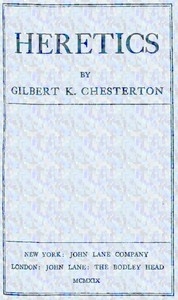
The source record for Heretics — Reading Companion measures this digital text at 68,308 words, 4 hr 57 min estimated reading time, and 22 detected text sections.
The text analysis averages about 20.8 words per sentence, while the detected sections provide another way to judge how the source is divided.
Project Gutenberg metadata also associates the work with “Apologetics,” connecting these edition facts with the source record’s subject description.
Explore this collection
These alternatives are selected using recorded categories and estimated reading time.
About 308 minutes
Adventure Picaresque Fiction
70,665 recorded words. 11 minutes difference from this book's estimate.
View Gutenberg source #5706About 354 minutes
Adventure Picaresque Fiction
81,411 recorded words. 57 minutes difference from this book's estimate.
View Gutenberg source #12171About 213 minutes
Adventure Picaresque Fiction
48,956 recorded words. 84 minutes difference from this book's estimate.
View Gutenberg source #57192Search stored excerpts and compare books → Choose by your preferences →
Choices use stored catalog measurements. Estimates vary with reading speed. A shared category is a catalog label, not a claim that two books have the same argument or literary quality.
Search reads excerpt text stored with this catalog and links to its associated Gutenberg record. The connection is stored in the site database; this tool does not recheck that every excerpt is word-for-word identical to that external record. Excerpt search does not cover every chapter and does not verify historical publication dates.
Catalog snapshot checked: 2026-09-26. Coverage: 96 public books, 96 available source excerpts.
Calculated from edition completeness, EPUB availability, text structure and catalogue metadata. Not a user rating.
Total of 100 points, scaled to a 2.5-5.0 range. Editions with an empty description or a missing EPUB file are not scored.
Public-domain source text
The source text is kept in the dedicated reader, separate from this catalogue record and its commentary.
Heretics opens with a series of vivid portraits of Edwardian intellectuals—Rudyard Kipling, George Bernard Shaw, H. G. Wells—each treated as a symptom of a wider philosophical malaise. Chesterton’s method is not systematic rebuttal but a kind of moral cartooning: he isolates a single trait (Kipling’s imperial restlessness, Shaw’s lifeless optimism) and inflates it until its absurdity becomes visible. The book’s structure mirrors this approach, moving from individual to general, from the particular heretic to the heresy itself.
The first half of Heretics proceeds by a series of character sketches, each chapter named after a contemporary figure. Chesterton treats these men not as opponents to be refuted but as case studies in a larger spiritual disease. His critique of Kipling, for instance, fastens on the phrase “the vast and varied world” as a cover for a narrow, restless patriotism. The method is deliberately unfair—Chesterton admits as much—but it allows him to dramatize ideas through personality. The portraits are not biographies; they are parables. By reducing a thinker to a single, exaggerated posture, Chesterton makes the abstract concrete. The reader is left not with a balanced assessment but with a memorable image: Wells as a man who believes in progress but not in humanity, Shaw as a puritan who has mistaken joy for pleasure.
Recurring images of the sea, the sun, and the stars give Heretics a submerged unity. Chesterton returns again and again to the idea that modernity has lost the capacity for wonder: “If we saw the sun for the first time it would be the most fearful and beautiful of meteors.” The sea becomes a symbol of that primal astonishment, something that cannot be tamed by explanation. In the excerpt on humility, he writes that “to the humble man, and to the humble man alone, the sea is really a sea.” These images are not decorative; they carry the argument. Chesterton’s case for dogma is also a case for the reality of the external world, which he fears is being dissolved into mere sensation or system. The stars, the sea, the light of common day—these are the anchors of his counter-claim.
One of the book’s central moves is the inversion of conventional values. Chesterton argues that humility, not pride, is the foundation of joy and knowledge. The pagan who set out to enjoy himself ended up enjoying nothing else; the Christian who reduces his ego to zero finds the universe renewed. This is not a pious platitude but a psychological claim: “Humility is the thing which is for ever renewing the earth and the stars.” Chesterton supports it with unexpected examples—Prussia and Japan, he notes, succeeded by copying others, a form of national humility. The argument is deliberately provocative, turning the Victorian cult of self-reliance on its head. The reader is asked to consider that the strongest nations are those that have “humbled themselves to be exalted.”
The book’s architecture is a gradual zooming out. Early chapters are anchored to specific names and books; later ones, such as the chapter on humility, float free of any single target. This movement mirrors Chesterton’s method: he begins with the heresy as it appears in a living person, then traces it to its root in a general error. The effect is cumulative. By the time the reader reaches the later chapters, the earlier portraits have become types. Kipling is no longer just Kipling but a symbol of the rootless modern soul. The structure thus enacts Chesterton’s own claim that the particular contains the universal. Each heretic is a microcosm of a larger disorder, and the book’s journey from individual to idea is itself a kind of argument for the reality of abstract truth.
Heretics is best read as a series of provocations rather than a systematic treatise. Chesterton’s strength lies in the unexpected connection, the image that sticks. The reader should attend to the rhythm of the prose—the way a paragraph will pivot from a joke to a sudden, serious claim. The book rewards those who are willing to be irritated, who will argue back. It is not a finished philosophy but a set of starting points, each chapter a door left ajar.
There’s a moment in Heretics where Chesterton makes you feel that dogma isn’t a cage but a lighthouse, something steady in the fog. It reminds me of that old An outline of humor Being a true chronicle from prehistoric ages to the twentieth century — A Reader’s Guide, which maps laughter the same way—patiently, warmly, as if tracing a coastline we’d almost forgotten we loved.
Answer a few questions and save a private reflection on this device.