About 208 minutes
Isaac Bickerstaff, Physician and Astrologer — Key Ideas to Explore
Adventure Picaresque Fiction
47,775 recorded words. 34 minutes difference from this book's estimate.
View Gutenberg source #2644
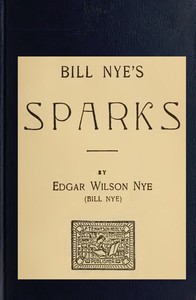
The source record for Bill Nye's Sparks — Context and Discussion measures this digital text at 39,871 words, 2 hr 54 min estimated reading time, and 5 detected text sections.
The text analysis averages about 22.9 words per sentence, while the detected sections provide another way to judge how the source is divided.
Project Gutenberg metadata also associates the work with “American wit and humor,” connecting these edition facts with the source record’s subject description.
Explore this collection
These alternatives are selected using recorded categories and estimated reading time.
About 208 minutes
Adventure Picaresque Fiction
47,775 recorded words. 34 minutes difference from this book's estimate.
View Gutenberg source #2644About 213 minutes
Adventure Picaresque Fiction
48,956 recorded words. 39 minutes difference from this book's estimate.
View Gutenberg source #57192About 121 minutes
Adventure Picaresque Fiction
27,772 recorded words. 53 minutes difference from this book's estimate.
View Gutenberg source #4695Search stored excerpts and compare books → Choose by your preferences →
Choices use stored catalog measurements. Estimates vary with reading speed. A shared category is a catalog label, not a claim that two books have the same argument or literary quality.
Search reads excerpt text stored with this catalog and links to its associated Gutenberg record. The connection is stored in the site database; this tool does not recheck that every excerpt is word-for-word identical to that external record. Excerpt search does not cover every chapter and does not verify historical publication dates.
Catalog snapshot checked: 2026-09-26. Coverage: 96 public books, 96 available source excerpts.
Calculated from edition completeness, EPUB availability, text structure and catalogue metadata. Not a user rating.
Total of 100 points, scaled to a 2.5-5.0 range. Editions with an empty description or a missing EPUB file are not scored.
Public-domain source text
The source text is kept in the dedicated reader, separate from this catalogue record and its commentary.
The collection opens with a mock testimonial for Dr. J. Burdock Wells' Bile Renovator and Gastric Rectifier, written by a fictional attorney named Alanson G. Meltz. Meltz claims his health was restored after one bottle, and he now offers "noiseless divorces" by mail from his office at No. 6 5/8 South Water Street. This piece sets the tone for the volume: a blend of deadpan satire, exaggerated self-promotion, and a recurring fascination with the absurdities of commerce and correspondence.
Throughout the sketches, Nye adopts a persona that is both naive and knowing, often addressing the reader directly with a straight-faced delivery that amplifies the humor. The structure of the collection is loose, moving between fictional letters, advice columns, and comic monologues, held together by the author's consistent voice and his eye for the incongruities of everyday life.
Several pieces in Bill Nye's Sparks are built around invented advertisements or testimonials. The most elaborate is the Meltz divorce notice, which includes a patient testimonial from a man in Kansas who writes, "Your recovery was indeed a great boon to me. You have saved my life." The humor lies in the conflation of medical cure and legal service: the same remedy that restores health also expedites divorce. Nye extends the joke by listing Meltz's credentials—"attorney and counselor-at-law, solicitor in chancery"—and offering "home treatment for divorce."
Another sketch, Requesting a Remittance, parodies the polite but desperate tone of dunning letters. The narrator's poverty is described with comic specificity: "I was out of coal half the time, and once could not mail my letters for three weeks because I did not have the necessary postage." These pieces share a structure: a formal or legalistic frame is gradually undermined by absurd details, revealing the gap between the pretensions of commerce and the reality of the narrator's circumstances.
Nye frequently returns to the image of the struggling professional—the lawyer, the journalist, the patent medicine salesman—who maintains a facade of success while living in near-destitution. In the biographical sketch that opens the volume, Nye describes his own early career as a justice of the peace in Laramie: "the office was not a salaried one, but solely dependent upon fees. So while I was called Judge Nye and frequently mentioned in the papers with consideration, I was out of coal half the time."
This motif recurs in The Drug Business in Kansas, where the narrator's pharmacy is a front for other enterprises, and in A Father's Letter, where a parent's advice is undercut by his own financial desperation. The contrast between official titles and actual hardship is a running joke, and Nye often literalizes it with precise numbers: the office at "No. 6 5/8 South Water Street" or the salary of "thirty dollars a month." These details ground the humor in a recognizable, if exaggerated, reality.
Many of the sketches take the form of letters, either from the narrator to a correspondent or from a fictional client. The Coupon Letter of Introduction satirizes the social obligation of providing references for strangers, describing letters "punctuated with invisible signals, calling upon me to remember that the bearer had looked over the writer's shoulder as each sentence grew into a polite prevarication." The piece proposes a standardized coupon system to replace the awkward personal letter.
Other pieces, like Answers to Correspondents and Written to the Boy, mimic the advice column or the parental epistle. The humor often arises from the mismatch between the formality of the letter format and the trivial or absurd content. Nye's ear for the rhythms of polite correspondence—the elaborate salutations, the hedging phrases, the false modesty—allows him to lampoon social conventions while maintaining a tone of earnest helpfulness.
The collection shifts rapidly between settings and personae. One sketch may be set in a Kansas drugstore, the next in Washington, D.C., and the next on a railway platform. In He Sees the Capital and More About Washington, Nye adopts the voice of a provincial visitor overwhelmed by the grandeur (and absurdity) of the federal city. In Big Steve and Speech of Red Shirt, he ventriloquizes a Western frontiersman and a Native American chief, respectively, using dialect and exaggerated rhetoric for comic effect.
This variety is held together by the consistency of Nye's narrative stance: the observer who is both part of the scene and detached from it. The movement is not linear but associative, jumping from topic to topic as if the reader were listening to a monologue. The effect is that of a comic lecture or a series of after-dinner speeches, where the pleasure comes less from plot than from the unexpected juxtapositions and the author's deadpan delivery.
Readers approaching Bill Nye's Sparks should expect a collection of short, self-contained pieces rather than a continuous narrative. The humor depends on recognizing the gap between the formal language of business and law and the messy realities they describe. Nye's persona—the impoverished professional who never quite loses his dignity—is the unifying thread. The sketches reward attention to detail: the precise addresses, the absurd product names, the carefully constructed testimonials. They are best read one or two at a time, allowing the comic voice to register without fatigue.
After laughing through Edgar Nye’s skewed legal notices, I found myself turning pages in Heretics — Reading Companion the same quiet afternoon. Both remind me how gently we let go of certainty—one through a wink, the other through a slower, steadier honesty. It felt less like finding an answer and more like remembering an old, familiar porch. Heretics — Reading Companion lingers that way.
A brief reflection can help important ideas stay with you longer.